



Mater Admissions MBA admissions consulting logo
GMAT Review
GMAT Review

February 3, 2012

The Round 3 Question

Some business school applicants are legitimately wondering whether they should go ahead and apply in Round 3 for the 2012 entering class.  Some realize that if they don’t apply in this round, they probably won’t matriculate this year. Others figure that they should take advantage of this one last chance to round out their choices.

If you are thinking of Round 3, take a look at the following list of do’s and don’ts. It just may help you decide whether to go through the process one more time. At the bottom of this post you’ll also find an unscientific list of schools that may be worth reviewing for third round. This does not mean that it’s a cakewalk, just that they may have more flexibility than, say, Harvard or Wharton.

You should apply third round if

  • You ran out of time second round and had some other target schools that interested you (and you fell within the profile of the class of 2013)
  • You improved your GMAT score by enough to put you within the target school’s range
  • You overlooked a school and, after taking a closer look, you think you might be a good fit
  • After going through the whole application process, you really realize you are less hung up on a top 5 name.
  • You are considering part-time programs when you only applied to full-time programs

You should NOT apply third round if

  • You only want to go to a top 5 school and you didn’t get into the top 4
  • You are outside of the school’s 2013 class profile
  • You aren’t sure what you want to do
  • The thought of filling out another application gives you a rash
  • You hate your job and it just occurred to you to apply to business school last week

If your scores/grades are lower than average/mean/standard distribution for your target school, take the time to retake your tests, or take a few courses in finance/accounting/business statistics and ace them.  If your work experience isn’t strong enough, take on more projects or a team leadership role.

The final round is not the death round; I know some very successful third-round admits at schools as competitive as Stanford.

As a bonus, I’m reposting excerpts from Harvard Business School admissions director Dee Leopold’s 2011 blog post about Round 3:

Round Three - Should You or Shouldn't You?
…You may be asking yourself whether it's worth your time and money to submit an application. Is it too much of a long shot?

…we always conclude that we like Round 3 enough to keep it as an option. Although we have admitted about 90% of the class by this time, we always - ALWAYS - see enough interesting Round 3 applicants to want to do it again. I know you wish I could define "interesting" with pinpoint accuracy but I can't. Sometimes it's work experience, sometimes it's an undergraduate school we wish we had more students from, sometimes it's a compelling recommendation …

So if you are interested in trying for HBS in Round 3, make sure you get your application in by April 10, 2012.

An Unscientific List of Third-Round Deadlines that Might Be Useful, (in date order)

Indiana Kelley 3/1

Carnegie Mellon Tepper 3/5

Duke Fuqua 3/8

Cornell Johnson 3/14  (R4)

USC Marshall 3/15

UNC Kenan-Flagler 3/16 (R4)

Texas McCombs 3/26 (R4)

UCLA Anderson 4/18


–Betsy Massar

Don’t forget to check out our new book Admitted: An Interactive Workbook for Getting Into a Top MBA Program


November 9, 2011

Wrestling with MBA Application Essays

You are thinner, of course

If you know anyone who is applying to business school for the class of 2014, you may have heard them muttering to themselves, “What does matter most to me and why?” (Stanford GSB) or  “Have I ever learned anything from a setback?”  (Harvard Business School) They may be victims of an energy-draining syndrome that shows itself every year about this time called MBA essay nightmare.  It’s a regular sinkhole of drafting, pondering, redrafting, questioning, redrafting, wondering if it is getting better or worse, redrafting, and whining.

The essays matter.  Of course the GMAT does too, and, but the real differentiator is the answer to the question behind all those questions, “Why should we admit you to our business school?”

Your answer is going to be as unique as your own DNA. But getting there is quite the chore. You could watch this MBA Podcaster video on YouTube regarding essays (in which I feature with admissions reps from Wharton and Columbia Business School), or you could read on.

I’m going to tell you a secret.  Writing isn’t easy for anyone.  Oh, every so often, someone will tell you that they whipped up their essays the night before the deadline and were accepted everywhere they applied.   Fine.  That person is in the minority.

If you are finding that you are writing and rewriting, and rewriting again, and then stumbling, and rewriting, you are not alone.  Ernest Hemingway was said to have rewritten the ending of “For Whom the Bell Tolls” 39 times. That’s just the ending.  That means he already struggled with getting words down on paper for the first time.  Remember the movie “Adaptation,” where the character played by Nicholas Cage nearly drives himself crazy from writers block?   That should remind you that lots of people have faced down a blank page.

To write those essays, you have to start somewhere, and believe me, your first try doesn’t have to be perfect.  In fact, it can be terrible. Annie Lamott, author of Bird by Bird, a wonderful book on the writing process, life, and everything else, says it is ok to write whatever comes into your mind. “For me and most of the other writers I know, writing is not rapturous," she says. "In fact, the only way I can get anything written at all is to write really, really shitty first drafts.”

Death by Rewriting

Or what if you are looking at an essay that you’ve rewritten two or three times, and it still isn’t going anywhere?  It feels like it is getting worse word by word. Don’t be afraid to stop writing.  Read it first thing in the morning if you are an early person, or right before you go to bed if you are a late person. Or both. Keep your computer or a pen and a printout of the draft by your bed.  Print it out, walk around with it.

If you hate it, talk the essay over with a friend, confidant, or advisor.  Tell them the story without worrying about the words on the paper.  Does it makes sense? Are you excited by it? If not, go back and forth with this other person: have them tell you when they feel your energy.  If they don’t feel your energy at all when you tell them your story, believe me, the admissions officer won’t feel it either.  You may have to start all over.

These are just some quick ideas to remind you that it is perfectly OK for you to feel stuck. This is really, really normal.  Just don’t be afraid to rewrite, revise, and reconsider your own assumptions.  You probably don’t have to go around 39 times, but give yourself permission to work it until it's right.

September 7, 2011

More MBA Schools Accept the GRE & GMAT

Hot off the press,  Kellogg's full-time MBA program now accepts the GRE.  As does Cornell's Johnson School.  Here's the updated list as of September 7, 2011. It's always great to check; it wasn't on the Kellogg website until I emailed and -- voila! There's no harm in asking!

School GRE? Link
Columbia YES Columbia Business School
Cornell YES Cornell Johnson
Darden YES UVA Darden
HBS YES Harvard Business School
INSEAD YES INSEAD
Kellogg YES Kellogg MBA
Mich Ross YES University of Michigan Ross
MIT Sloan YES MIT Sloan
NYU Stern YES NYU Stern
Stanford YES Stanford GSB 
Tepper YES Carnegie Mellon Tepper
Texas YES Texas McCombs 
Tuck YES Dartmouth Tuck 
Wharton YES Wharton MBA
Yale YES Yale School of Management 
Duke MAYBE Duke Fuqua 
Cambridge NO Cambridge Judge
Chicago NO Chicago Booth 
Haas NO UC Berkeley Haas
LBS NO London Business School
Oxford NO Oxford Said
UCLA NO UCLA Anderson 

If you are looking for more schools the ETS link has a full list of MBA programs which accept the GRE.

May 24, 2011

Thank You Women of Washington DC

Filed under: Application ideas,Inspiration,Wharton — Tags: , , , , , — admin @ 7:03 pm


The 85 Broads DC Chapter is outstanding! Last Tuesday, I was able to talk to about 30 wonderful chapter members about Leadership & the MBA. With the help of Jhaymee Wilson, and Wharton EMBA graduate, Joy Quinn, we covered a lot of ground.

We talked about a number of resources for potential students of graduate business or joint programs.  I of course shilled my own blog, posted on 85 Broads and on the Master Admissions website. There you can find useful tips on getting your quant skills MBA ready , standardized testing skillsrecommendation wrangling, and storytelling at the interview .

We also talked about other resources, and for great material and zero cost, I cannot recommend MBA Podcaster enough.  This site is filled with balanced audio and video resources – it’s sophisticated and easy to navigate.  I’ve learned a lot from this site, and am a big fan of the founder, Leila Pirnia, an MIT entrepreneur.

But Wait, There's More!

Very briefly, here are a few more resources we discussed:

Fellow 85 Broad member Alison Levine – her website is here at alisonlevine.com.

Daniel Goleman, the author who popularized “Emotional Intelligence” discusses this subject in the original Harvard Business Review article on “What Makes a Leader?”  A discussion of how this all applies to business school and essay writing can be found here.

List of business schools that take GRE as well as the GMAT

TED talk on the brain’s plasticity by Jill Bolte Taylor

Finally, in our discussion of the brain and learning, one member mentioned books by Steven Pinker,

If I am forgetting anything, please let me know! It was a wonderful evening, and I look forward to hearing more from the wonderful, exciting, emerging leaders of Washington.  You ladies rock!

April 7, 2011

Advice from a Recently-Admitted Wharton MBA

A student I worked with, let's call her Jennifer, was recently admitted to Wharton (really) and waitlisted at her first-choice school, let's call it Kellogg. While waiting, she agreed to offer advice from the trenches, of one who succeeded in the process. She discusses four issues: staying committed to the goal, receiving feedback, waiting (lists), and financial matters. This is very useful stuff!

STAYING COMMITTED
I am so glad that I reapplied. I was rejected from the four top business school programs I applied to three years ago (all without an interview). While it stung to get so little traction in the business school process, I did not take it as a sign that I wasn't "meant" for business school. Instead I tried to understand the weaknesses in my application and knew that I would try again and do it better. I have learned so much in the application process and am very happy I have even more experience that I can bring to business school when I attend.

RECEIVING FEEDBACK
Get feedback! Make sure the people you are asking have something valuable to add to the process and take the time to listen -- better to find two people who will give you great feedback than send your materials to 10 people and listen to no one.

Also, be strategic in your decisions about who you want to use for help in the application process, and seek out those people early on. Make sure you really WANT someone's feedback before asking for it; I have been on both sides of the equation. Recently, a friend asked for feedback on his essays. I spent a lot of time on his essays and when I returned them it seemed that he hardly looked at my suggestions. He was giving me the essays because he thought that was what you were supposed to do, but had little interest in following up on the suggestions or incorporating feedback.

WAITING FOR DECISIONS AND THE WAITLIST
In terms of my advice for people who have been waitlisted or general feedback for students after they have applied: the most valuable thing I've done in my application process is turn every moment I have been frustrated into an opportunity to do something. When I found myself going crazy waiting for one program to get back to me while another waited on my decision, I brainstormed a list of all the things I had accomplished since I applied and wrote a letter to the school where I was waitlisted explaining those accomplishments. I created a campaign fueled by waiting and (sometimes) panic and created something productive. I am so glad I did this, because the time you spend sitting anxiously waiting and checking MBA chat forums is, in the end, not useful (though I did that too).

FINANCIAL ISSUES
Given the calculus course I am taking and other requirements, I have completely neglected to begin financial planning and thinking about the costs and consequences of my decision. I wish I had done this in a systematic way earlier, not only so that I would be better prepared and informed about my choices and responsibilities, but also because finances are an important part of my final decision (for instance, I am trying to make a decision about two programs that cost vastly different amounts of money). Now I am finding myself overwhelmed at the process of tackling everything right now. If I had to do it again, I would start planning and filling out financial aid information earlier and getting the advice of students, faculty, family and others about their tips on going through the process.

March 9, 2011

GMAT, GRE, LSAT and Your Brain

Starting to think about taking the GMAT, GRE or LSAT?  This is actually the time to start looking into courses, figuring out whether you want to take a class or get a private tutor, or whether doing the online/whiteboard route works for you. You can find variations that suit your timeframe, learning style, and temperament.

Test Anxiety is Normal
Taking tests is a subject that is near and dear to my heart.  I want you all to know that I was a TERRIBLE test taker. My SAT scores were so low that I was laughed out my top choice undergraduate schools. (I eventually had to transfer into Vassar from a state school).  So when I was thinking about applying to graduate school, the hold-it-all back side of my brain flipped out. Eventually, I ended up teaching that emotional bundle of neurons to shut up and let me be the test taker I thought I ought to be. And it worked: I scored in the 93rd percentile, with roughly equal math and verbal scores. Oh, and I got into HBS, Stanford Business School, Chicago, Wharton, and Darden.  Cool, huh?

I’ve been thinking about this experience because I’ve been reading an old classic of leadership training, Emotional Intelligence, by Daniel Goleman.  He describes a situation a lot of us know only too well: test anxiety. He describes, in scientific detail, an emotional hijacking.  This is where the limbic system, (the part of the brain that tells the body to breathe, pump blood, and run away from predators) disrupts the “working memory.”  So if you’ve ever been in a situation where you sit down at a computer screen in a noisy and unpleasant test center, here’s what’s probably going on.

The prefrontal cortex is the brain region responsible for working memory. But circuits from the limbic [most primitive brain part] brain to the prefrontal lobes [the rational/working memory part] mean that signals of strong emotion – anxiety, anger, and the like—can create neural static, sabotaging the ability of the prefrontal lobe to maintain working memory.

This limbic system is the hotbed of emotions. The limbic system, which includes the amygdala, if you’ve ever heard of it, is screaming to you as you look at the test questions, “Run away, it’s too scary! You will fail!”

Well, guess what. That amygdala is useful sometimes, but it tends to overreact. And that’s where the thinking, reasoning brain comes in. The prefrontal cortex tells the panic-stricken limbic system that all is not out of control.

The problem is that the cortex sometimes takes awhile to figure out that it needs calm your hysterical primitive, running from-the-burning-house brain. You are sitting in a noisy and fear-inducing test taking center. You know you should be spending no more than two minutes per question. And you are not even conscious of all this stuff going on inside your grey matter!

You Can Get Over It

The task is to teach yourself how to speed up the “thinking brain’s” work and quell those fears.  It takes lots and lots of practice, and it can be done.

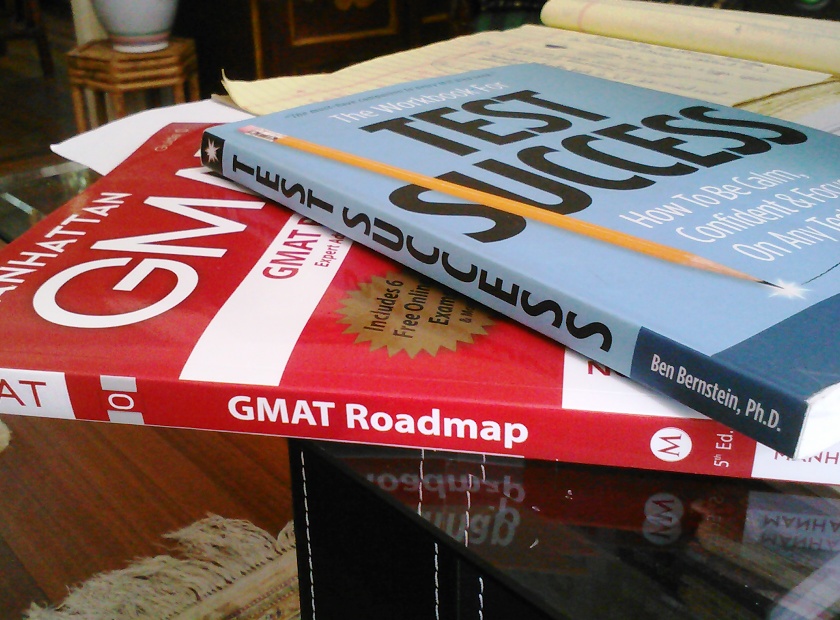
I’ve got lots of suggestions, and most of them can be found in a previous article I wrote called Train Your Brain for Test Success: Mastering Test Anxiety.” But if you want to cut to the psychological chase, pick up a copy of Dr. Ben Bernstein’s Workbook for Test Success. He’s an experienced psychologist who knows how to put that amygdala back in line.

If I figured out how to do it, anyone can. I personally know a few standardized testing (GMAT and GRE) tutors whom I like, and rather than shout out here, I am happy to take your calls and make recommendations.   Take a breath and good luck!

December 9, 2010

Non-Traditional MBA Candidates and "Bizability"

It’s funny, but almost everyone I know is a non-traditional candidate for their MBA. And it scares them.  They think everyone else applying to business school comes from consulting or finance, and those not from those fields should just give up. We all know a few consultants, investment banking types, and more than a few engineers at business school. And indeed, if you look at the profiles of many business schools (here’s a link to the Wharton MBA site, where you will see a combination of 37% for those in finance and private equity).  But thousands of others from backgrounds in the arts, social enterprise, hard science, start-ups, and the military will make their way to MBA program of their choice in the fall of 2011. Really.

It’s a Master of Business Administration

Here’s something that most people don’t understand: getting into business school is not just about leadership.  Indeed, leadership is very important, and may be one of the most important elements of the application, but understanding what makes a business enterprise work is probably just as important.  Dee Leopold, the famed director of admissions at Harvard Business School, calls this business acumen “bizability.”  I wrote about it in a previous blog post, last August after watching her presentation to prospective students. Bizability is so important, that it is worth going over again.

The term bizability reminds students that they are (nearly always) applying to a school of business.  The degree is called a Master of Business Administration.  The Yale School of Management had tried for two decades to sell its Master of Public and Private Management (MPPM) degree, but the school officially changed the name to the MBA in 2000.   Business is about commerce, about enterprise, and even in the case of non-profits, it’s about making money. Dee Leopold described it as being “grounded in the language of business.”

Bizability means that students have to, at some level, like business. I once met a student who wanted a joint degree in education and business to fund a school, but she hated business. She didn’t care about it; she didn’t appreciate finance, she just thought it was all evil.  That is not a great admissions strategy. You have to like business well enough to have been exposed to what makes a company tick and want to learn more.

Drawing upon your own experiences

It doesn’t mean that you have to work in the private sector to “get” business.  You have to be able to appreciate what makes businesses work well. For those of you who have only worked in non-profit or government, think hard about where you have used actual business skills to succeed. Have you run – or do you work with — the budget for your department? Do you know how to read financial statements?  Do you follow the business press?  Have you ever run your own little business? You don’t have to answer “yes” to all of these questions, but they cannot scare you.

So think about what business school is about and what having a career with a business degree means. Think about words like industry, commerce, management, enterprise, company, market, trade, and finance. Do you have an affinity for any of these ideas? If so, you are on your way, and are perhaps not so scarily non-traditional after all.

July 27, 2010

Upcoming Bay Area MBA Admissions Events

This is that time of year where you have your pick of many events. .  It's not too early to start talking to MBA admissions officers, and to help you plan your events, I've posted below a list of receptions that are already on the calendar.  Below the list of individual school events, I've added below the group panels and fairs that might also be interesting. Please note that this list is not exhaustive, and I will be updating it.

I hope to see you at some of these gatherings -- they should be fun and helpful as you make your choices.  Meanwhile, if you have any questions about business school, applications, or what to do next, please call, and let's talk about it!

Betsy Massar
Master Admissions

8/10/10
Date
Business School
Time
Location
Registration & Info
7/28/10
Harvard
6:30 pm
Gap, 2 Folsom St., SF
8/4/10
Wharton
7:00 PM
Yahoo! 710 1st Ave, Bldg C, Sunnyvale
8/5/10
Duke Fuqua
7:00 PM
JW Marriott Union Square, SF
8/5/10
Mich.- Ross Women's event
6:30 PM
SF Marriott Marquis, 55 4th St, SF
8/10/10
Wharton
7:00 PM
Wharton West, 101 Howard St., SF
8/12/10
UC Berkeley Haas (Part-Time)
7:00 PM
UC Berkeley Haas, Room C230
8/18/10
Columbia
6:30 PM
TBD
Starting 8/30/2010
UC Berkeley Haas (Full-Time)
1:00 pm -
2:00 pm (daily)

UC Berkeley Haas, Room C250

9/13/10
Tuck
7:00 PM
Stanford Court Renaissance, 905 California, SF
9/23/10
Chicago Booth

7:00 PM

PG&E, 245 Market St, SF
9/29/10
Yale
6:00 PM
Wells Fargo Bldg. 420 Montgomery St., SF
10/6/10
MIT Sloan
TBD
TBD
10/14/10
Mich. Ross
TBD
TBD
10/25/10
UVA Darden
TBD
TBD
11/10/10
UC Berkeley Haas (Full-Time)
6:30 PM

Wells Fargo Bldg. 420 Montgomery St., SF

Ongoing Mondays & Fridays
Stanford (on campus in Palo Alto)
11:45 am - 1:00 pm
GSB South Building, Room S151
*Dates TBD
NYU Stern, Kellogg, Stanford (in SF)

Group events:

8/16/2010: Penn Club event with Harvard, Kellogg, MIT Sloan, Stanford, Wharton
9/12/2010: QS World tour note -- LBS' only scheduled SF visit (so far)
9/14/2010: Forte Forum -- note: INSEAD only scheduled SF visit
9/26/2010: MBA Tour -- note: UCLA only scheduled visit (so far)
If you have any questions about the lists above, please let me know,

Betsy Massar
Master Admissions

July 20, 2010

The GMAT (or GRE) and Tunnel Vision

Filed under: Application ideas — Tags: , , , , , , , — admin @ 10:31 am

It seems like I haven’t blogged in a while, and for that I apologize.  This past week I went back to the east coast and got to meet with admissions officers from some excellent schools: Georgetown, Cornell, and Wharton.  Each has its own strength – in Georgetown’s case, I would say the location is a very big plus, Cornell has a wonderful social enterprise program, and Wharton is, well, Wharton.

But while meeting schools’ admissions officers was important (and a great part of my trip), I learned something that I wanted to write about here about the GMAT, inspired from conversations with Doug Barg.  Doug is head of the GMAT faculty at Kaplan in Philadelphia, but he is so much more than that.  He is, on Twitter, “GeeMatters” and blogs and he really knows how to teach.

One thing that stood out in our conversation is a story this GMAT expert told me about focus.

The Key: Focus

Focus is critical for standardized tests. I’ve written about it a number of times, including a paper called “Train Your Brain for Test Success.”  Focus keeps you on track so that you pay attention to the question at hand, and not the worrying voices in your head. Focus  helps you answer the question quickly, and not second-guess.

When the stakes are really high, sometimes its hard to focus.  Doug told me about a student who taught himself to focus by thinking about his former colleague in the US Army whose job was to diffuse bombs.  How did he prevent IEDs or landmines from blowing up?  Focus.

Says Maj. Chris Hunter, a counter-terrorist bomb disposal specialist expert in the British Army:

"When you walk up to a bomb to neutralise it by hand, the adrenaline is flowing and you go into tunnel vision mode to try to dispel any fear you’ve got. Adrenaline helps," he says. "You’ve got to steady your breathing and can feel the drum beat of your heart."

Was the soldier born that way? Probably not.  He trained, over and over, practiced when where the stakes were much lower, to keep his focus.  It can be learned.

OK, not everyone has such nerves of steel, but we can be inspired by the soldier’s training.

When you study, practice on your focusing techniques.  Channel the Explosive Ordnance Disposal guy.  Practice that tunnel vision. You’ll waste a lot less energy, and maybe even feel like you’ve saved the world.

July 7, 2010

10 Tips for Getting into Business School — Tip 9: Work Only on What You Can Control

Welcome back to the 10-Tips series.  We're down to the wire -- here on Tip 9, Work Only on the Part You Can Control.

I was anxious about mentioning the element of chance involved in the business school application process. I didn’t want the excellent applicants, along with the hard-working, underappreciated admissions committee professionals, to think that I am calling it crap shoot. It’s not. But you cannot control the entire process, particularly the outcome.

It’s Your Strategy
You cannot control the ultimate outcome, but you have some power to influence the inputs. Let’s take undergraduate grades. Think your GPA is a done deal? How about an alternative transcript? Take courses you overlooked, or even flubbed, when you were an undergraduate, then get A’s, and you have put your GPA in context. How about the GMAT? Test prep resources are readily available -- I can recommend several programs and methodologies to help you improve your score and stay sane. And as we’ve discussed, your career path is in your control as well. (See Tip 2 on career progression).

Practical Tactics
Here are some tactical things you can absolutely control: the schools you visit and choose to apply to, when you are going to apply (what year? what round?), and very importantly, whom you ask to be your recommenders. You can take them out for coffee and share your aspirations. See if they are on board with doing the thoughtful and time-consuming work of writing the best recommendation.

You can also control the application timetable. Applying to business school is a huge undertaking with lots moving parts. You absolutely need to get all the bits and pieces together by the deadline… in the right time zone. Believe me, I know someone who did miss the deadline because of a time-zone issue; it happens.

Still, you cannot control the entire process. You cannot control who else is applying, or what the economy will look like when you hit “send.” You cannot control the mood of your application’s reader, or when your application is read within a cycle (some schools are more flexible about that, but trying to game it will make you crazy). You cannot control what the universe decides is the outcome. You just can’t.

From a Wharton Student Expert
I’m not the only one who believes there is some chance involved – in fact, I got the courage to write about this point from a forum post on Wharton’s Engage website (a great resource!):

Says Victor M. Lee, Wharton, class of 2011,
To some extent, yes, there is an element of luck. As applicants, we cannot control who else applies. But I would contend that the vast majority of the application process is under your control (how you choose to put your application together, where and how you choose to interview, how much you do in research into Wharton, how much introspection you perform, how well you do on standardized tests and previous academic coursework, how effective and accomplished you are in your career and extra-curricular activities, etc).


Besides, would the reward be so sweet if you knew the answer in advance?

Older Posts »
© 2008-2012 Betsy Massar, Master Admisisons, Berkeley, CA. All Rights Reserved.