



Mater Admissions MBA admissions consulting logo
GMAT Review
GMAT Review

May 9, 2012

What You Can Do NOW to Boost Your MBA Application

With deadlines for MBA applications about six months away, you might think there's not much you can do to prepare right now other than take the GMAT or GRE. Even if you’re planning to apply to schools next year, you may think that your profile as a candidate is already set in stone.

Line up here

But the truth is, you can always improve—and whether you’re a few months or years out, you’ve got time to plan your campaign and enhance your application. Admissions officers are looking for several key things—ability to handle academic rigor, career progression, and leadership potential. "Virtually every MBA program looks for students who exhibit intellect and leadership," writes Derrick Bolton, Director of MBA Admissions at the Stanford Graduate School of Business

Here are three concrete ways you can demonstrate your potential to admissions officers—and even beef up your future employability, too.

 Take Undergraduate Quant Classes

Because business schools are very quantitative, they want to know that you can do the work that’s required. Plus, potential employers will be happy to see that you can handle numbers as well."We want to be sure that you will be able to handle the rigor of Tuck’s quantitative program." says Pat Harrison, associate director of admissions at Dartmouth's Tuck School.

You might think your GPA, that C+ in economics, or the fact that you’ve never taken calculus will doom you—but that’s not the case. You can take an online calculus or business statistics class from any number of accredited universities now, and use those grades on your business school applications. In many cases, accredited, graded courses can mitigate a less-than-perfect undergraduate record.

Another option is a specialized pre-MBA program, like the Tuck Online Bridge program, which offers courses in a number of disciplines, including managerial economics (statistics). If you’re just trying to beef up skills and don’t care about a grade, take a look at MBA Math, which offers very practical lessons in financial math, statistics, accounting, and microeconomics.

Demonstrate Your Career Progression
Admissions officers and potential employers are looking for people who have moved forward and will continue to advance in their careers. Chicago Booth's evaluation criteria includes "track record of success, resourcefulness,and sense of personal direction." Success doesn’t necessarily mean title advancement—rather, it’s about taking on an increasing level of responsibility. And not just when it’s offered.

Naturally, if your boss assigns you to spearhead a new product, run with it. But if that opportunity isn’t handed to you, you can volunteer to mentor new employees on your team, or develop an outreach program to educate internal clients about your group’s initiatives.

You can also ask for additional assignments that might teach you about a different part of the company. As long as your boss doesn’t think you’re leaving your current assignments unfinished, see if you can broaden your experience. Ask to join an existing firm-wide committee, or simply offer your services when you see someone else feeling overwhelmed.

These are little things that can expand your influence within your current position and propel you to a promotion, whether it’s official, unofficial, or even into another company. And even if you don’t get that promotion before you turn in that b-school application, the extra responsibilities and your initiative will reflect well on you.

Expand Your World
You can also look outward to the community to increase your leadership experience. "Our students...have to be seen as people who are creating value in society," said Harvard Business School Dean Nitin Nohria.  I’m not suggesting that you merely add to your list of extra-curricular activities—the way you are involved in an activity can tell an admissions committee member more about you than can a lengthy list of organizations. So, look at what you’ve already been involved in and where you can deepen your leadership role and have a greater impact on your organization.

If you’ve been tutoring at-risk youth, for example, you might create and implement a strategic plan to bring on more volunteers to your group. Or if you’ve been raising funds for an annual 10K, you could develop relationships with corporate sponsors who may be able to help year after year. These types of activities can illustrate your initiative and long-term planning skills, and can be incorporated into the stories you tell in your essays.

As a business school applicant, you always have the potential to learn and grow—even in the months before you apply. Continuing to add to your portfolio of skills and achievements as you’re selecting schools and studying for the GMAT will show a propensity toward mature leadership—and that’s something admissions officers can’t wait to read about.

April 4, 2012

Why You Should Take a Test Prep Course

I'm surprised that so many students who want to go to graduate school don't feel the need to take a test-prep course. Most of them are well worth the investment.

I can’t stand standardized tests. They test only one thing: test-taking ability. But they are here to stay, and students who want to earn their MBA , or other top professional program from a top school, should get really high scores. Especially in quant.

Both the GMAT and the GRE, the former being the primary business school entry hurdle, are computer adaptive tests.  That means that more correct responses will lead to harder questions. So those who suffer even the slightest anxiety about the test are faced with another layer of uncertainty. First, there’s the voice that says, “I am afraid I don’t know the material.” Then there’s the voice that says, “I don’t have enough time to answer” and now there’s the voice that says, “this question is easier than I had expected…so I must be doing badly!” It’s exhausting.

This is Your Brain on Anxiety
The brain doesn’t like these conversations. Neuroscientific research has taught us that such anxiety hijacks our ability to think. In very simple terms, limbic system, (the part of the brain that tells the body to breathe, pump blood, and run away from predators) disrupts the “working memory.”

A test prep course, or, if you prefer, a one-on-one tutor, can help you reduce that anxiety, and at a minimum, improve your ability to recall information.

Let’s look at the benefits one-by-one.

1. You will learn the material – the test looks for analytic ability, especially in the quantitative section. You need to brush up on your math. Certainly you can do it from books on your own, but the test is designed to trip you up. Call it mean-spirited. The knowledge itself is important, but you want somebody to walk you through the way to think about the problem.

2. You’ll improve your timing – It’s a timed test, so you need to be very efficient in your responses. You cannot skip a question and you cannot go back. At a minimum, a course or tutor can help you become familiar enough with the material so you can use your precious minutes figuring out the answer rather than figuring out the question.

3. Focus – Standardized tests are about the process of taking the test as much as they are about the material. A good course and a good teacher will teach you how to approach your studying and your test taking. You should take advantage of the prep coach or company’s resources to learn how to master the process.

4. Discipline – You cannot cram for a test like the GMAT. According to Doug Barg, a former master GMAT teacher at Kaplan and a very smart guy, you should study for at least three months, preferably six. Check out his classic blogpost here. If nothing else, a course will help you break up the studying so that you will not only learn, but retain more. A course will also encourage you to take more practice tests than you will on your own. It just works that way.

5. Confidence – A course will help you be more confident. It will help you practice, which should help you feel more confident.  And the more genuinely confident you are, the better you’ll score.

It’s possible that you do not suffer from anxiety; not everyone is that high strung. In that case, a course can only help you improve even more dramatically by familiarizing yourself with material and test process. And you are being measured against all other test takers, many of whom will have taken a course.  You are competing; why wouldn’t do whatever you can to get the edge?

A formal training program with a teacher or coach is worth the investment. There are lots of classes, online courses, tutors, coaches, and more. I know trainers at Manhattan GMAT, Kaplan, Veritas, Test Prep NY (good for test anxiety), Knewton, and new players like Magoosh (interesting! worth checking out) I also know some awesome individual tutors. I can get you discounts on some of them, introduce you to others, or just talk it through. Just email me at betsy@masteradmissions.com for a chat.


October 28, 2011

Around the World: Six Tips from the Trenches

Here's an article by my colleague and friend, Candy LaBalle, founder of mbaSpain on international student approaches to the MBA admission process

MBA admissions consultants help applicants in everything from choosing schools to essay brainstorming to resume editing. But, when dealing with non-US applicants, we also have to do a little cultural translating. At mbaSpain, I face this reality every day, and, after comparing notes with several AIGAC colleagues, I’ve identified six application areas where cultural awareness is essential.

1. Sell Yourself

Call it branding, positioning, or tooting your own horn, what is second nature to US applicants is often taboo to non-Americans.

“With Middle Easterners, particularly women, I spend a lot of time encouraging them to talk openly about themselves, their accomplishments and initiatives, and their dreams,” notes Tanis Kmetyk, who handles EMEA applicants for Accepted.com. With Asian applicants, she says, “Standing out is not considered a ‘plus’… so helping them to, well, stand out, is important.”

In addition, many foreign applicants believe an MBA application means all business. Rocio didn’t think the fact that she co-founded one of Spain’s most important youth sporting events to be relevant. “But I was in university, wouldn’t the schools rather hear about my banking experience?”

2. Embrace your Failures

“Even physical hurdles that people face (like handicaps) are seen as a weakness in many countries,” says Tanis. We have to push them to realize that the value of that failure, what they learned can actually be a strength for their application.

Some non-US applicants try to avoid sharing failures by thinly veiling achievements. Jaime was determined to tell LBS that his failure to graduate number one in his class (instead of number two) was due to his demanding role as captain of the rugby team! It took a bit of coaxing to help him realize that his initial struggle with leadership was actually a more powerful story.

3. Answer the Question

Getting non-US applicants to clearly tell a story is another struggle. Vince Ricci who runs VincePrep.com in Japan notes, “Japanese storytelling emphasizes context – a long wind-up before the final punchline.” With this approach, they’ll run out of words before they get to the point.

Spanish applicants love to share mucho ruido, pocas nueces (a lot of noise, few nuts). Though it is good advice for all MBA hopefuls to stay focused and answer the question, non-US applicants benefit immensely from the application of STAR: Situation, Task, Action, Result.

4. Commit to the Tests

Standardized tests provide their own cultural challenges. Victoria Pralitch of MBA Consult in Russia says “My applicants see GMAT as just a math test, and our schools in Russia give a great math training, so no need to overstrain. As a result, the percentage of those who pass successfully the first time is not that high.”

“German applicants are typically exasperated about the GMAT requirement,” notes Dr. Marlena Corcoran of Athena Mentor. “They are convinced they are superior candidates, and their less-than-stellar scores on a standardized exam must mean the exam is unfair.”

Other applicants choose to ignore their English test until it is too late. “I have a 720 on GMAT and use English everyday,” Pedro, a very promising candidate told me last November. “I don’t have to prepare TOEFL.” He got a 104 and had to put off his Harvard application for a year.

5. Recognize Extracurriculars

“Most Western Europe governments take care of their people from ‘cradle to grave,’ so community activity here is not at all the same as it is in North America,” notes Tanis.

Maybe our non-US applicants haven’t done typical extracurricular activity, but most likely they’ve played team sports, served on an events committee at work, helped a family member open a business, or participated in some activity that allowed them to take initiative, have impact and show leadership.

Ricardo was convinced he had no extracurricular activity to share. Then I found out that when he was in university, his family went bankrupt. He used his computer skills to make 20,000 euros in an online venture which helped his father get his business back. Talk about impact!

6. Go Beyond Rankings

“I have to educate my non-US applicants about the diversity of schools – many are just focused on the top 10 and it’s frustrating, whether it’s not realistic for them or just there’s a better fit,” says Yael Redelman-Sidi of Admit1MBA.com based in New York.

While a top-ten obsession is typical among most MBA applicants, non-US applicants also face the cultural pressure of attending a brand-name school. Everyone in Spain, China and Brazil knows Harvard, not so many know Babson or Kelley or Tulane. It is our job to mediate their expectations (not all of them can go to Harvard) and open their eyes to other schools that could be a better fit.

September 7, 2011

More MBA Schools Accept the GRE & GMAT

Hot off the press,  Kellogg's full-time MBA program now accepts the GRE.  As does Cornell's Johnson School.  Here's the updated list as of September 7, 2011. It's always great to check; it wasn't on the Kellogg website until I emailed and -- voila! There's no harm in asking!

School GRE? Link
Columbia YES Columbia Business School
Cornell YES Cornell Johnson
Darden YES UVA Darden
HBS YES Harvard Business School
INSEAD YES INSEAD
Kellogg YES Kellogg MBA
Mich Ross YES University of Michigan Ross
MIT Sloan YES MIT Sloan
NYU Stern YES NYU Stern
Stanford YES Stanford GSB 
Tepper YES Carnegie Mellon Tepper
Texas YES Texas McCombs 
Tuck YES Dartmouth Tuck 
Wharton YES Wharton MBA
Yale YES Yale School of Management 
Duke MAYBE Duke Fuqua 
Cambridge NO Cambridge Judge
Chicago NO Chicago Booth 
Haas NO UC Berkeley Haas
LBS NO London Business School
Oxford NO Oxford Said
UCLA NO UCLA Anderson 

If you are looking for more schools the ETS link has a full list of MBA programs which accept the GRE.

April 25, 2011

Asian Women Applying in Droves

Filed under: Inspiration — Tags: , , — admin @ 10:20 am

Betsy with 1997's future leaders


I just got off the phone with a Bloomberg BusinessWeek  reporter discussing the trend in women's applications to business school.  It has completely skyrocketed, especially in Asian countries, where the vast majority of test-takers are women.  For example in China, never known to be a capitalist country, 63% or  19,000 women took the GMAT in test year 2010.  I'm still trying to figure out the biggest driver -- are Chinese women going to rule the world?

From these numbers, it looks like it.  But my guess is that the type of women and the type of leaders modern business schools will graduate will not try to be a Master of the Universe, but in fact, someone who will be a pioneer in her field.  Business schools have changed their approach to leadership so that it isn't about being a senior manager, or having a corner office, but instead about changing the world. And lucky for us, thousands of young women around the world, particularly in developing countries, are drawn to business school programs.

I'm just starting to think this through, but if any of you have any thoughts on why numbers of women from developing countries are overwhelming the number of men from similar far-flung locales, please drop me a line at betsy@masteradmissions.com


March 17, 2011

Business Schools that Accept the GRE or GMAT

More and more business schools are accepting the GRE in lieu of the GMAT these days. In response to a query I received from the academic adviser to students at one of the world's top undergraduate schools, I thought I would put together a handy table for you to identify which schools accept either the GRE or GMAT. Below you can see that many do, but not all.

SCHOOL

GRE?

LINK

Columbia YES Columbia Business School
Darden YES UVA Darden
Fuqua YES Duke Fuqua
HBS YES Harvard Business School
INSEAD YES INSEAD
Mich Ross YES University of Michigan Ross School
MIT YES MIT Sloan
NYU YES NYU Stern
Tuck YES Dartmouth Tuck
Stanford YES Stanford GSB
Wharton YES Wharton MBA
Yale YES Yale School of Management
Chicago NO Chicago Booth
Cornell NO Cornell Johnson
Haas NO UC Berkeley Haas
Kellogg NO Kellogg
UCLA NO UCLA Anderson

If you have any questions about updates to this information, please email me at betsy@masteradmissions.com

A few notes: Cornell does not indicate it accepts the GRE, but they haven't said they *don't* accept it, as Haas and Chicago Booth have. UCLA Anderson's MBA program doesn't accept it, but their Executive Program does.

Further, things do change! so please check the links and make sure the information you have is current.

Meanwhile, if you need any advice on studying for standardized tests, please see last week's blog post on test anxiety and your brain.

March 9, 2011

GMAT, GRE, LSAT and Your Brain

Starting to think about taking the GMAT, GRE or LSAT?  This is actually the time to start looking into courses, figuring out whether you want to take a class or get a private tutor, or whether doing the online/whiteboard route works for you. You can find variations that suit your timeframe, learning style, and temperament.

Test Anxiety is Normal
Taking tests is a subject that is near and dear to my heart.  I want you all to know that I was a TERRIBLE test taker. My SAT scores were so low that I was laughed out my top choice undergraduate schools. (I eventually had to transfer into Vassar from a state school).  So when I was thinking about applying to graduate school, the hold-it-all back side of my brain flipped out. Eventually, I ended up teaching that emotional bundle of neurons to shut up and let me be the test taker I thought I ought to be. And it worked: I scored in the 93rd percentile, with roughly equal math and verbal scores. Oh, and I got into HBS, Stanford Business School, Chicago, Wharton, and Darden.  Cool, huh?

I’ve been thinking about this experience because I’ve been reading an old classic of leadership training, Emotional Intelligence, by Daniel Goleman.  He describes a situation a lot of us know only too well: test anxiety. He describes, in scientific detail, an emotional hijacking.  This is where the limbic system, (the part of the brain that tells the body to breathe, pump blood, and run away from predators) disrupts the “working memory.”  So if you’ve ever been in a situation where you sit down at a computer screen in a noisy and unpleasant test center, here’s what’s probably going on.

The prefrontal cortex is the brain region responsible for working memory. But circuits from the limbic [most primitive brain part] brain to the prefrontal lobes [the rational/working memory part] mean that signals of strong emotion – anxiety, anger, and the like—can create neural static, sabotaging the ability of the prefrontal lobe to maintain working memory.

This limbic system is the hotbed of emotions. The limbic system, which includes the amygdala, if you’ve ever heard of it, is screaming to you as you look at the test questions, “Run away, it’s too scary! You will fail!”

Well, guess what. That amygdala is useful sometimes, but it tends to overreact. And that’s where the thinking, reasoning brain comes in. The prefrontal cortex tells the panic-stricken limbic system that all is not out of control.

The problem is that the cortex sometimes takes awhile to figure out that it needs calm your hysterical primitive, running from-the-burning-house brain. You are sitting in a noisy and fear-inducing test taking center. You know you should be spending no more than two minutes per question. And you are not even conscious of all this stuff going on inside your grey matter!

You Can Get Over It

The task is to teach yourself how to speed up the “thinking brain’s” work and quell those fears.  It takes lots and lots of practice, and it can be done.

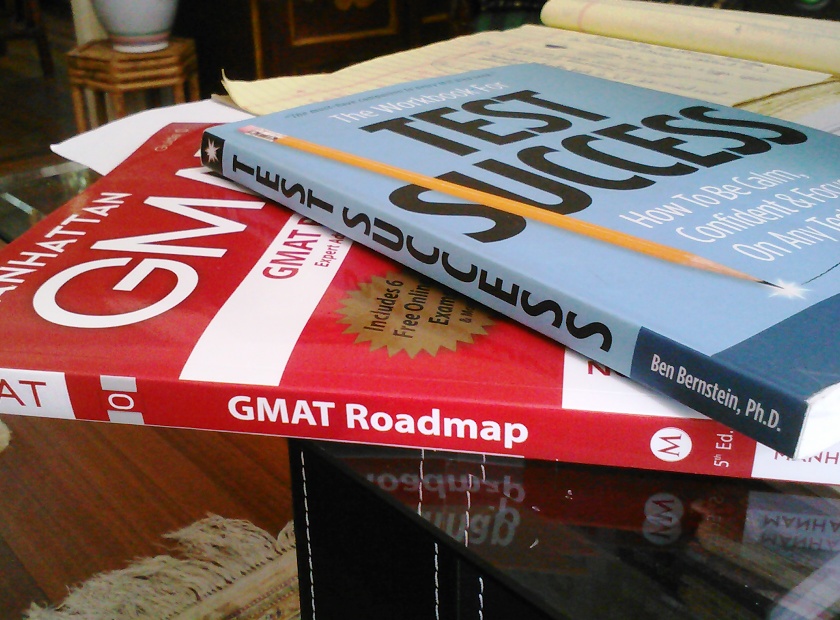
I’ve got lots of suggestions, and most of them can be found in a previous article I wrote called Train Your Brain for Test Success: Mastering Test Anxiety.” But if you want to cut to the psychological chase, pick up a copy of Dr. Ben Bernstein’s Workbook for Test Success. He’s an experienced psychologist who knows how to put that amygdala back in line.

If I figured out how to do it, anyone can. I personally know a few standardized testing (GMAT and GRE) tutors whom I like, and rather than shout out here, I am happy to take your calls and make recommendations.   Take a breath and good luck!

July 20, 2010

The GMAT (or GRE) and Tunnel Vision

Filed under: Application ideas — Tags: , , , , , , , — admin @ 10:31 am

It seems like I haven’t blogged in a while, and for that I apologize.  This past week I went back to the east coast and got to meet with admissions officers from some excellent schools: Georgetown, Cornell, and Wharton.  Each has its own strength – in Georgetown’s case, I would say the location is a very big plus, Cornell has a wonderful social enterprise program, and Wharton is, well, Wharton.

But while meeting schools’ admissions officers was important (and a great part of my trip), I learned something that I wanted to write about here about the GMAT, inspired from conversations with Doug Barg.  Doug is head of the GMAT faculty at Kaplan in Philadelphia, but he is so much more than that.  He is, on Twitter, “GeeMatters” and blogs and he really knows how to teach.

One thing that stood out in our conversation is a story this GMAT expert told me about focus.

The Key: Focus

Focus is critical for standardized tests. I’ve written about it a number of times, including a paper called “Train Your Brain for Test Success.”  Focus keeps you on track so that you pay attention to the question at hand, and not the worrying voices in your head. Focus  helps you answer the question quickly, and not second-guess.

When the stakes are really high, sometimes its hard to focus.  Doug told me about a student who taught himself to focus by thinking about his former colleague in the US Army whose job was to diffuse bombs.  How did he prevent IEDs or landmines from blowing up?  Focus.

Says Maj. Chris Hunter, a counter-terrorist bomb disposal specialist expert in the British Army:

"When you walk up to a bomb to neutralise it by hand, the adrenaline is flowing and you go into tunnel vision mode to try to dispel any fear you’ve got. Adrenaline helps," he says. "You’ve got to steady your breathing and can feel the drum beat of your heart."

Was the soldier born that way? Probably not.  He trained, over and over, practiced when where the stakes were much lower, to keep his focus.  It can be learned.

OK, not everyone has such nerves of steel, but we can be inspired by the soldier’s training.

When you study, practice on your focusing techniques.  Channel the Explosive Ordnance Disposal guy.  Practice that tunnel vision. You’ll waste a lot less energy, and maybe even feel like you’ve saved the world.

April 19, 2010

10 Tips for Getting into Business School — Tip 2 Take Inventory

Welcome to the second of my 10-Tip series to help you in your campaign to get into business school. The first tip encouraged you to start early – because indeed, it is a campaign, and the earlier you start thinking about the whole process, the easier it will be to put this massive project together.  I cannot recall anyone I have ever met in my life who has said, after all is said and done, “That was a lot easier and took a lot less time than I thought!”

Tip 2 encourages you to take inventory. Business school admissions committees look for self-awareness, and what better way to figure out what you’ve already got and what you need, but an inventory list.  It’s ok to be lacking in certain areas, by the way.  No candidate is absolutely perfect.  Believe it.

Fill in Your Weak Spot: Career Progression

Let’s start with your work experience.  What kind of a track record of success have you demonstrated in your career so far?  You don’t have to have invented the iPad, but you should have made a difference in your work environment.  Were you put on the fast-track? Promoted faster than expected? Were you responsible for changing the way your group does business?  The varieties of ways you can have made a positive difference on your workplace are endless.  The important thing is to identify a pattern of excellence in your nascent career.

Often admissions officers talk about career progression – being able to explain how you went from point A to point B. Does it make logical sense?  If there’s something missing from that progression – say you work for a government entity that doesn’t accelerate promotions – can you gain more responsibility in another way, even if it requires taking on extra work?  Maybe you need to round out your leadership experience by leading a team, inside or outside the office.  If there’s no easy opportunity in the workplace, you can look to your community or entrepreneurial activities to round things out.  Remember to push your own limits – show that you know how to do something that goes beyond what is required.

Fill in Your Weak Spot: Academics

If your grades are good, but not great, you might want to take some business courses to show the admissions committee you know how to sit in a classroom and excel. I’m a big fan of the alternative transcript; I had a terrible undergraduate GPA myself.  Once I focused on what I wanted to do with my life, I took night classes in math, statistics, accounting, finance, marketing, and received all A’s. This not only showed the admissions committee that I had the discipline and smarts to take all these classes and juggle a workload, but that I was interested and committed to a business education.

Even if you have a great quantitative/business background, you might want to round out your education with a course that’s unexpected, like in interpersonal communications, oral presentation skills, or theater.  It turns out that these skills are core skills required of business school students.  For example, Stanford GSB Duke Fuqua and MIT Sloan business schools consider improv part of the curriculum. It may sound crazy, but all of these tools help the geek in us so we can be more creative in our problem solving.

Fill in Your Weak Spot: GMAT Scores

Unfortunately, there’s no substitute for strong GMAT scores, and it helps to score over the 80% percentile on the quantitative portion of the test. (That’s the benchmark Berkeley Haas uses to determine which students need to take a math prerequisite.)  If you haven’t taken a prep course, I highly recommend it. It’s worth the investment.  If you are having trouble, find a tutor to help you learn how to take the test. The test-prep companies have a stable of great people, or you can go to a specialized tutor If you are still having trouble, explore other options like a test anxiety expert.

Inventory Yourself

As you go through the inventory of what you bring to the admissions table, you may find yourself  overwhelmed.  Don’t panic.  Slow it down. If you really want it, but aren’t ready yet, this may not be the right year for you. Performing an inventory tells you how compelling your case is right now.  If you want to beef up your profile, let’s get started.  But you’ve got to first figure out what you’ve got, and what you need.  This end of the admissions process is up to you.

April 11, 2010

To Dare Greatly

Many of the results are in.  Most aspiring MBA students who submitted applications this season know where, and if, they are going to business school. Some students will not get their wish – they will have applied to one or many schools, and were not admitted anywhere.

I believe that the act of applying is worth applauding. It’s a complex project, practically requiring a Gantt chart for project scheduling: take GMAT course, take GMAT test, visit schools, write essays, request transcripts, get recommendations and follow up, follow up, follow up. For those who really put their all into it, you know who you are, and you deserve congratulations.  Despite the official outcome, you learned something from the process.  Irrespective of the admit/deny decision, you are a stronger, more self-aware person for having gone through it all.

Making it through an ordeal is a worthy outcome.  I learned this by spending time with my friend Rich this weekend. He is an amazing guy – a master sailor who, last year, raced a 60-foot sailboat around the world, unassisted. Thirty boats started the race and only 11 finished.  It took him 121 days (4 months!), napping at  15-minute intervals, in the midst of gale force winds, ice gates, and autopilot failure. He was 58 years old at the time. He has had severe asthma since he was a baby. He’s one tough guy, and also the most humble guy I know.

He is an inspiration to me, when I think of my own challenges, and an inspiration to schoolkids world over who learned from Rich’s adventure on his website.

Curiously, Rich found camaraderie with the other skippers in the race – whom he was supposed to be competing against.  After one sailor, who was forced to drop out of the race because of a severely damaged mainsail, told Rich he was devastated and disappointed with himself, Rich sent him quote from Theodore Roosevelt, about failing while “daring greatly.”  It’s an important quote that  I would like to pass along to all those who might have tried, but did not succeed, to gain admission to business school, or who might not have landed that perfect job.

"The credit belongs to the man who is actually in the arena, whose face is marred by dust and sweat and blood; who strives valiantly; who errs, who comes short again and again, because there is no effort without error and shortcoming; … who at the best knows in the end the triumph of high achievement, and who at the worst, if he fails, at least fails while daring greatly, so that his place shall never be with those cold and timid souls who neither know victory nor defeat.” T   Roosevelt

What a great quote!  Rich really believes it, and that’s why he’s such an inspiring guy.  As he has said over and over, less eloquently, but equally powerfully, “The important thing is to participate.”  I agree.

And if you’ve got the fortitude to try it all over again, there’s always next year.

Older Posts »
© 2008-2012 Betsy Massar, Master Admisisons, Berkeley, CA. All Rights Reserved.