



Mater Admissions MBA admissions consulting logo
GMAT Review
GMAT Review

April 23, 2012

Want to get into b-school? Be yourself!

What's the first thing that comes to mind when you hear the word "authentic?" My bet would be that you don't automatically think of an MBA student. But someday, you just might.

Why? The top business schools are not only looking for applicants with academic potential, but they’re seeking out a new breed of leader—­someone who’s passionate, collaborative, and wants to make a difference in the world. They want applicants with more than good grades, impressive scores, and a letter of recommendation from the likes of Bill Clinton. They’re looking for people who can use their hearts and souls when making business decisions—leaders who are authentic.

Many applicants shudder at the thought of revealing themselves in a business school application (“what if I look imperfect?”). But believe it or not, that’s OK! If you try to be the person you think schools want to read about, you’ll end up sounding just like every other candidate out there. So, take a look at these do’s and don’ts that will help you show business schools your true self—and your leadership potential.

Do: Be Yourself

It’s corny, but according to Mary Miller, Assistant Dean of Admissions at Columbia Business School, it works—and it’s exactly what admissions committees are looking for. “Be yourself,” she advised in a BusinessWeek interview. “We're all unique individuals; we all present ourselves in a unique way…After you read 10,000 applications, it's pretty easy to pick out who really shares themselves.” So do some self-exploration before you start writing. Figure out your own motivations and influences to get in touch with the genuine you.

Don’t: Presume You Know What They Want to Hear

Don’t model yourself after admitted applicant “essays that worked.” Admissions readers are wise to the templates that are out there, and they’ll take away from your own authenticity.

Instead, write what you want people to read in your application essays. As Director of Michigan Ross MBA Admissions Soojin Kwon Koh says, “the uniqueness comes when you answer questions using your own experiences and your own points of view developed through your unique way of processing experiences. An off-the-shelf approach is a sure way to distinguish yourself—in a negative way.”

Do: Learn By Doing

Of course you can take Myers Briggs or Enneagram tests to determine your leadership style—but the best way to develop it is to go out and make things happen. Take on a new responsibility at work, join a non-profit steering committee, or mentor someone who could benefit from your expertise—and use those experiences to talk about your leadership potential. Take note of how you work with others when you are faced with challenges and actively seek feedback on ways to improve.

Don’t: Be Like the Tin Man

Harvard Business School Admissions Director Dee Leopold claims that the best candidates have a “Wizard of Oz” combination: brains, heart, and courage. We all know plenty of smart, gutsy people—some of whom have risen to the top of their organizations. But many are missing a crucial ingredient: heart.

Authentic leaders show heart, which comes in the form of their dedication to their purpose, and their commitment to their values. Throughout the application process, don’t be afraid to reveal your passion—it’s this quality that makes someone a leader worth following.

Do: Stand Proud of Your Success

It’s OK to be excited about your accomplishments—in fact, you should showcase them in your essays and interviews. Tell stories to illustrate your experiences and potential. . Just don’t forget to acknowledge the contributions of your teammates and supporters too. . Success is something you should be proud to share, but chances are, you didn’t get there alone.

Don’t: Brag

While showing pride can be an asset, don’t get carried away—you can be gracious about your accomplishments without boasting. Dwell on your accomplishments too long, and you risk sounding like what cynics call the “typical MBA,” not a future leader. Also, don’t be afraid to own up to your mistakes. Nobody’s perfect, and admitting that you’re fallible can demonstrate maturity.

As you begin to prepare your essays and applications, you may think your own stories aren’t so interesting. In reality, the opposite is true—the more genuine you are, the more interesting your stories become. That authenticity will improve your chances for admission, and pave the way for success—in business school and beyond.

This article originally appeared in The Daily Muse.

April 9, 2012

How to Make the Most of Your MBA: A Primer for Entrepreneurs-to-Be

This week's tips come courtesy of Alison Albeck Lindland, a fellow Vassar graduate who went on to get her MBA from Columbia Business School, graduating in 2008.  Prior to business school Alison worked on the Goldman Sachs and Jaguar accounts at OgilvyInteractive and was an early team member at TheaterMania.com, a startup media and ticket software company. After graduating from CBS, she worked at

Alison Lindland and colleague

American Express Interactive, and is now director of business development at Kohort, a venture-backed  group management and event planning platform.

Alison says these tactical pointers cover a potential entrepreneurship career. Personally, I think her recommendations apply to anyone hoping to take a big jump into something new and different careerwise.

  • Get to know everyone in your cohort. There’s a temptation to gravitate to the people you are just going to be friends with or have to work with in study team but guaranteed you’ll be missing out on some terrific people and contacts.
  • Network with your classmates. Once you’ve identified the industry or area of focus that you want to pursue after graduation use all the internal databases and  or LinkedIn to identify current classmates who worked in that field and do coffee chats with them. I met lots of great classmates who I otherwise would never have met socially, whose background ranged from telco engineers who gave me mini tutorials in how mobile tech actually works to mobile entrepreneurs who had worked on interesting early mobile dating apps.
  • Get to know your professors personally and tell them what you’re interested in.  Having gone to a small liberal arts school, I came from a mindset where you always got to know your profs personally and would have them over to your house for dinner.  Most business schools are not this way so you can really stand out if you make an effort and you never know what it will yield.
  • Seek out opportunities to TA for your favorite profs or help with their research.  I TA’d for Prof. Whadwa’s excellent strategy consulting class for a session for the Exec MBA class.  This a great chance to get to know my favorite professor better, and to know 65 terrific Exec MBA students.
  • Volunteer to help out institutes or think tanks in your school.  You would be surprised how many institutes and think tanks your school funds.  Though the smaller ones may not have a great profile to students you would be surprised to learn how many industry and high profile alums may be involved.  At CBS I was thrilled to discover the Columbia Institute of Tele-Information and I simply walked in, introduced myself and said I wanted to get involved.  Turns out they were in the early stages of planning a Location Based Services conference for the summer . Given my contacts from my summer doing mobile at Amex, they were happy to enlist me.  It was without a doubt one of the best experiences I had in school.
  • Get off campus and talk to everyone.  If you’re nervous about cold-emailing people for networking coffee chats, start with the guest speakers in your courses. Connect with them in person before they left the actual classroom and follow up that day asking for a coffee.  It’s a great warm intro and usually you’ll know more about what they’re working on after the talk.  In my case, if they could not meet with me, they would give me someone else to talk to.
  • But if you’re nervous about cold emailing people - don’t be.  Being an MBA gives you carte blanche to reach out to people - it is what professionals expect of MBAs.  Just say you’re really interested in something related to their career or company and can you come to their office for a 20 minute coffee chat.  90% of the time people said yes to this request - and again, if they didn’t I’d ask them if there was someone else I could talk to. Remember to make networking hay while the MBA sun shines.  And set yourself a target - like 3 a week so you keep doing these.
  • Take a class in another school or that is widely cross registered. MBAs are great but you’re going to spend most of your career working in cross functional teams - why not get to know these people (lawyers, journalists, designers, developers etc) now.
  • Lastly, I’d be remiss if I didn’t remind you to go to all the happy hours and on some major group trips.  You’re working hard in school and this is a great way to recharge and really grow those relationships - plus you’ll never have time in your adult lives to do things like this again.

Phew! It's exhausting, but that's the beauty of the MBA experience -- it's all there for you if you want it.


--Betsy Massar, taking a leaf from the Alison Lindland playbook. For those who want to jump in and experience the busy and rewarding MBA experience, make sure you set yourself up for success with Admitted: An Interactive Workbook for Getting Into a Top MBA Program.

April 4, 2012

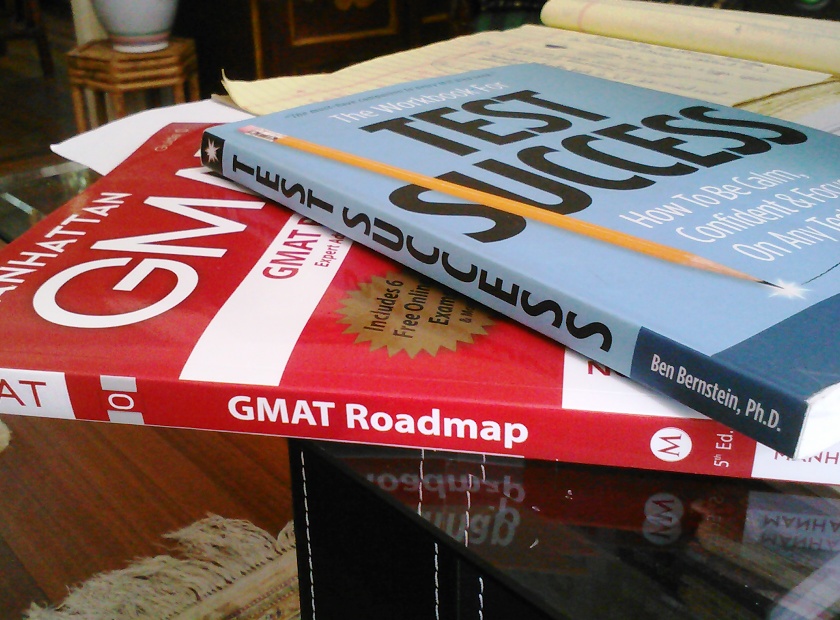
Why You Should Take a Test Prep Course

I'm surprised that so many students who want to go to graduate school don't feel the need to take a test-prep course. Most of them are well worth the investment.

I can’t stand standardized tests. They test only one thing: test-taking ability. But they are here to stay, and students who want to earn their MBA , or other top professional program from a top school, should get really high scores. Especially in quant.

Both the GMAT and the GRE, the former being the primary business school entry hurdle, are computer adaptive tests.  That means that more correct responses will lead to harder questions. So those who suffer even the slightest anxiety about the test are faced with another layer of uncertainty. First, there’s the voice that says, “I am afraid I don’t know the material.” Then there’s the voice that says, “I don’t have enough time to answer” and now there’s the voice that says, “this question is easier than I had expected…so I must be doing badly!” It’s exhausting.

This is Your Brain on Anxiety
The brain doesn’t like these conversations. Neuroscientific research has taught us that such anxiety hijacks our ability to think. In very simple terms, limbic system, (the part of the brain that tells the body to breathe, pump blood, and run away from predators) disrupts the “working memory.”

A test prep course, or, if you prefer, a one-on-one tutor, can help you reduce that anxiety, and at a minimum, improve your ability to recall information.

Let’s look at the benefits one-by-one.

1. You will learn the material – the test looks for analytic ability, especially in the quantitative section. You need to brush up on your math. Certainly you can do it from books on your own, but the test is designed to trip you up. Call it mean-spirited. The knowledge itself is important, but you want somebody to walk you through the way to think about the problem.

2. You’ll improve your timing – It’s a timed test, so you need to be very efficient in your responses. You cannot skip a question and you cannot go back. At a minimum, a course or tutor can help you become familiar enough with the material so you can use your precious minutes figuring out the answer rather than figuring out the question.

3. Focus – Standardized tests are about the process of taking the test as much as they are about the material. A good course and a good teacher will teach you how to approach your studying and your test taking. You should take advantage of the prep coach or company’s resources to learn how to master the process.

4. Discipline – You cannot cram for a test like the GMAT. According to Doug Barg, a former master GMAT teacher at Kaplan and a very smart guy, you should study for at least three months, preferably six. Check out his classic blogpost here. If nothing else, a course will help you break up the studying so that you will not only learn, but retain more. A course will also encourage you to take more practice tests than you will on your own. It just works that way.

5. Confidence – A course will help you be more confident. It will help you practice, which should help you feel more confident.  And the more genuinely confident you are, the better you’ll score.

It’s possible that you do not suffer from anxiety; not everyone is that high strung. In that case, a course can only help you improve even more dramatically by familiarizing yourself with material and test process. And you are being measured against all other test takers, many of whom will have taken a course.  You are competing; why wouldn’t do whatever you can to get the edge?

A formal training program with a teacher or coach is worth the investment. There are lots of classes, online courses, tutors, coaches, and more. I know trainers at Manhattan GMAT, Kaplan, Veritas, Test Prep NY (good for test anxiety), Knewton, and new players like Magoosh (interesting! worth checking out) I also know some awesome individual tutors. I can get you discounts on some of them, introduce you to others, or just talk it through. Just email me at betsy@masteradmissions.com for a chat.


March 20, 2012

Hoop Dreams and the March Madness of Admissions

Waiting to get admitted is enough to drive a person mad. So mad, that it's a wonder that the admissions process didn't grab the name "March Madness" before college basketball did. The expression goes back to 1939, but it has only been used in relation to the NCAA basketball tournament since 1982. (North Carolina over Georgetown by a point).

Not quite the NBA

As an admissions professional, I see many similarities between the two--not just the anticipation, operatic emotions, and decisions rendered in March and April. They are both magnificent, if not dangerous, obsessions. I’ve listed five major similarities below, and a bonus of one big difference. Disclosure: my experience is mostly with the competitive world of MBA and professional graduate programs, but with a little imagination, we can all stretch it to college admissions, job hunting, and anything else with beautifully unpredictable results.

1. Competitive strategy
Like the NCAA basketball tournament, you have to compete to get into the school of your choice. There are more contenders than spots.  Not all talented entrants even qualify.  That’s because the league they come from might be semi-professional, like the ACC or the Big East.   It’s kind of like being a mediocre analyst at McKinsey – you know you are playing with the big boys, but you might not get invited to the Big Dance.

2.  First-round washouts
These days, most selective MBA programs require an invitation-only interview. That means that you might know pretty early on that you’ve been disqualified.   Some highly-seeded teams fall out early – Duke surprised everyone this year.  Still, I’ve seen people who have been dinged without interview from Harvard but got into Stanford.  It’s never rational.

3. The Gamble
Face it. You’ve got some money and pride riding on the outcome: You spend months of time and energy studying for the GMAT or GRE, you have to beg your boss for a recommendation, and if it all works you get bragging rights for a lifetime.  Well, at least until September.  The good news is that you are vindicated, even if everyone else thought you were crazy.

4. Being an expert makes no difference
You can parse the rankings all you want, argue that Kellogg is more prestigious than MIT Sloan or the other way around. That the Economist is crazy to rank Harvard behind … UVA?  No one is objective; not fans, not referees, not players.  Admissions committee members are similarly not entirely objective; they are human too! Like basketball, admissions is much more an art than a science.

5.  You’ll never know until you try
If you don’t play, you can’t win.  And if you lose, you can lick your wounds; but if you want it, you’ll keep trying. You may fire your coach and change your strategy, but you’ll get back on the court. You could be the next Cinderella team. Keep your eye on the ball and you could be in the Final Four before you know it.

Oh, there are some differences. In the case of admissions, you probably never take time away from work to work on an application or check its status, as you might for an exciting game. You probably never talk about it ad infinitum with friends and family, or go out for beers after its all over. And naturally, you don't fork over $150,000 if you win. Last time I checked.

-- Betsy Massar

February 28, 2012

Leadership Do's & Don'ts Learned from the Oscars

While Joan and Melissa Rivers commented on Oscar styles, Master Admissions focused on the lessons for leadership, especially for those

Surprise! Angie was a don't!

thinking about applying to business school, a job, or accepting an international award. Here are five takeaways from the Oscars that will resonate with MBA wannabees.

1. Have a brand, but be humble: The Oscars are known for glitz and glamour, not for authentic emotions. Some say the same for MBAs.  So even if the odds are in your favor, like they were for Octavia Spencer, show your humility. It’s a powerful way to command respect.

2.  But don’t go overboard on what you show and how you show it: Angelina Jolie didn’t need to strike a pose, and when she did, leg and all, she played the fool.  Prospective MBA’s want to know not to act too impressed with their talents.

3.  Use your age to your advantage:  Christopher Plummer had no apologies about his 82 years and showed the world that he was hardly over the hill.  Grace, maturity, and a sense of humor about yourself will always add to the conversation.

4. Give credit where credit is due: Meryl Streep thanked her husband first and her hair and makeup guy second.  She showed leadership by broadening the spotlight to include her important teammates.  And we loved her for it.

5. When in doubt, go global: Although the Oscars are in Hollywood, the stage was international.  Whether from France, Iran, or surprising the audience with fluent German like Sandra Bullock, we all speak the same language. It’s a small world after all.

These lessons are a good reminder that leadership shows up whether you are honored for your accomplishments--or letting the spotlight shine on your colleague. The world is a stage, and let's face it everyone has a little Hollywood in them.

---Betsy Massar

This post is a condensed version of the March 1 Forbes article.

Betsy Massar is founder of Master Admissions and author of Admitted: An Interactive Workbook for Getting into a Top MBA Program , published by 85 Broads. A graduate of Harvard Business School, she has worked on Wall Street for Goldman Sachs and in the financial markets in the US, Europe, and Asia. In addition, she has been a business journalist and a communications coach at the Stanford Graduate School of Business. 

February 22, 2012

LOL: Managing Stress While Waiting

It's a tough time in the admissions cycle.  At least for prospective students. Most have submitted applications and are waiting for interviews, or have had interviews and are waiting for decisions. There’s an absence of information that ‘s unnerving. It’s just plain stressful. So is waiting for a job offer or waiting for a chance to be in the starting lineup of the New York Knicks.

So, what do you do?

Laugh.

Who's laughing last?

I got this idea from Martha Beck, a well-known life coach who also happens to be  sociologist with three degrees from Harvard (BA, MA, and PhD).  She wrote the following line and reading it today just hit me right.

The more stressful, dangerous, baffling, or unpleasant your situation, the more important it is to laugh at it.

She's right.

Scientific proof that laughing works

We all know intuitively that laughter is the best medicine, and research backs up this aphorism. Scientists at the University of Maryland Cardiac Medical Center found that clips from humorous films like “There’s Something About Mary”  caused arteries to expand, increasing blood flow to the heart. The Brits have taken it one step further, declaring that laughing in a social setting increases endorphins, that is, mitigates pain.  Or, as the researchers stated in the proceedings of the Royal Society of Biological Sciences, “The results show that pain thresholds are significantly higher after laughter than in the control condition. We suggest that laughter, through an endorphin-mediated opiate effect, may play a crucial role in social bonding.”

So what does this tell you?  Stare that empty email box in the face and laugh right at it. Or put yourself on a steady diet of old reruns of Arrested Development, Monty Python, The Simpsons, old John Belushi sketches, or funniest cat videos.

Some Reading Too

I actually recommend picking up a good book too. Books often take longer and grab more of your idle brain matter than a movie, or a Daily Show news report. I’m sure there are some scientific studies that measure brain relaxation waves while escaping through the pages of a book.  I hate to admit it, but I actually found the Hunger Games riveting.  You won’t learn any new vocabulary words, but you’ll keep turning the pages; it’s a guilty pleasure.

I’m also reading a whole bunch of books on the brain and happiness; I’ve always been interested in the brain and the mind, and after reading Delivering Happiness, by Zappos founder Tony Hsieh, I stumbled upon Stumbling on Happiness, by Dan Gilbert. Essentially, he, like Sonja Lyubomirsky, author of The How of Happiness, find that we consistently get wrong what we think will make us happy.

So, if you are all wrapped up in your single-minded pursuit of getting exactly what you want *right now*, relax, laugh at it, laugh at yourself, and if you are still having trouble cracking a smile, laugh at me.  That’s what my whole family does, so why not you?

– Betsy Massar

Don't forget to check out the Betsy Massar's book Admitted: An Interactive Workbook for Getting Into a Top MBA Program, available on Amazon.

January 19, 2012

What is the Best Business School for a Career in Finance?

Because I worked for Goldman Sachs right out of business school, later worked in investment management, and now consult with companies like BlackRock, lots of people ask what MBA program they should attend if they want a career in finance.  And they also wonder if they should go to graduate school at all. For the purpose of this article, let's assume you want to pursue an MBA.

Riches can be yours!

Here’s what it does not depend on: rankings.  Rankings have something to do with what business school or finance degree you might want to research, but they won’t tell you whether it’s the right program for you.   And rankings are all over the place.  A few months ago, I wrote a blog post on this subject with lots of quotes from the Assistant Dean at Dartmouth’s Tuck School of Business. Tuck has been ranked overall #1, #6, #7, #14, #18, depending on who you talk to, and encourages students to look beyond the actual listing.

Figuring out the Right Path

So which of the top schools might be better in corporate finance, or M&A, or hedge funds, or private equity? Is Wharton better in finance than Harvard, or is Stanford the best way to get a job in venture capital?  There are a lot of opinions all over the internet – and many of them are simply wrong.  So what should you believe?  You’ve got several ways to figure this out.

1.  See who is recruiting at your target school.  Not everyone gets a job on campus, but take a look at the recruiting list for any school. You can usually find it through their employment report. Here is Columbia Business School’s  employment report, for example. The list of recruiters starts on page 10. Or here’s UC Berkeley Haas’ list of companies that have come on campus.  Examine it carefully. You might not find some of the big New York PE shops, but you’ll find Cambridge Associates, which for you, might be an even more likely stepping stone into venture capital, private equity, or hedge funds.

2.  Visit the schools and/or talk to students about their experiences. With LinkedIn and Facebook, you must know someone who knows someone.  Many schools put student contact information right on their website, for example, see this list of student ambassadors from Michigan Ross or NYU Stern. Others, like Harvard Business School, present interviews of students—who are all easy enough to find if you look hard enough.

3.  Investigate clubs at your target business school. Columbia’s Private Equity and Venture Capital Club has its own website, and don’t be fooled by the log-in.  Just jump to club officers, and you’ll have plenty to work with.  More interested in Chicago? Booth doesn’t just have a finance club, it has a  corporate finance club, an investment banking club, a PE club, and and even a distressed investing and restructuring club.

4. Talk to actual people in your target industry and find out what paths they took. While the big guys in the PE industry look like a straight shot from Morgan Stanley M&A, venture capital, hedge funds, and other investment firms might have a more circuitous route. Hey, Mitt Romney came to the private equity business by way of management consulting, so why can’t you?

5. Network.  This is essentially the same as item #4, but it’s so important that I am mentioning it again.  Because you want to hit the ground running once you get to business school, it makes sense to start building your contacts now. Brian DeChesare, an expert on breaking into Wall Street, encourages prospective financiers to “network like a ninja” because, “even if you’re at Harvard you can’t rely on on-campus recruiting.”  And even if you get an interview through on-campus recruiting, you want to have friends who can help you actually land the job and do well there.

And in the meantime, have fun with the process. You’ll learn a lot and meet lots of people. And it’s definitely more enjoyable than signing up on e-Harmony.

--Betsy Massar

Don't forget to check out our new book Admitted: An Interactive Workbook for Getting Into a Top MBA Program

December 10, 2011

Authenticity, the Real You, and the MBA Application

self-exploration or self-excavation?

Here's how to get into your top-choice business school: be yourself. If you are struggling with MBA essays, the last thing you want to hear are those two words, but that's the secret. I know it seems like a cliché, but admissions officers say over and over that they want to get to know YOU in the essays. Allison Davis, Associate Director of Admissions at Stanford Graduate School of Business wrote those very words in a blog post, even calling them “corny, but true.”

Get Real
The only way for you to do that is to show your authentic self. Not the person you think the committee wants to read about. I guarantee this one fact: YOU are more interesting than that mythical person. They want to read about your successes and foibles. I recall an admissions officer from Berkeley’s Haas School of Business remark that he loved reading the stories where people learn from mistakes or failure. Those stories show a lot about a person’s true character. Remember, every business school class is made up of human beings, and the more you show who you really are, the more you will stand out from the crowd of generic applicants. No kidding.

Dawna Clarke, Director of Admissions at Tuck, blogs about the importance of showing the “real you.”  She reminds applicants that the admissions process is designed to facilitate self-reflection and should help you to genuinely understand yourself—something you take with you regardless of where you get in.  Clarke writes:

Perhaps the most important thing to keep in mind is to be yourself. It goes without saying that the best thing you can do is walk away from your business school application experience knowing you put your best in front of the admissions committee for consideration. Regardless of the decision outcome, you'll have no regrets and, hopefully, you have learned a little about yourself along the way.

When your authentic voice comes through, it makes your application credible and demonstrates confidence.  Says the Stanford Graduate School of Business admissions website (look under the heading “Personal Qualities and Contributions”):

In a world that often rewards conformity, the Stanford community thrives only when you share your individual experiences and perspectives.  As a result, the strongest applications we see are those in which your thoughts and voice remain intact.

To understand how you will contribute to and benefit from the Business School community, we want to know about you: your experiences, beliefs, your passions, your dreams, your goals…most Stanford MBA students have excelled by doing ordinary things extraordinarily well. It is what you make of an experience that matters to us, not simply the experience itself.

You may be thinking, oh, I am just another cookie-cutter engineer/investment analyst/consultant/IT specialist.  But you aren’t. You are you, the real you. The more authentic “you” that shows in your application, the better your chances. Promise.

November 22, 2011

On a Great One-Page Resume

You use a cleaner font, I'm sure

Everyone who has applied to an MBA program or applied for any job worries about their resume.  How on earth do you fit your entire life story into one page?  And what an insult that someone actually thinks you can?

Your resume has almost nothing to do with your real life. It’s about your professional life, and it’s about your achievements.  I have heard MBA admissions officers and career advisors say that the resume is not a list of job duties. It is a record of your accomplishments.  That means you don’t need to put in the stuff that bores even you.

For example, I had a client who worked for a financial startup, so she wore many hats on the job. She created new financial tools, traded securities, and established deep relations with new and existing clients.  She also handled the monthly newsletter, which took a lot of time, but didn’t represent her highest talent.  So we cut it.  She’d already shown achievement in her other, more productive areas of her job, so she emphasized the best part.

Follow the Rules, It’s Easier
Remember, you have three-to-five bullet points per job, and anything longer than two lines per bullet becomes too dense for the reader, so put in the highlights: your tangible, measurable accomplishments, using active verbs and concise language.

Still, the resume has one place where you can show your individuality – the “Additional” section. Everyone reads that stuff. Promise. You have two or three lines to talk about interests, skills, and all that other stuff. Any hobby is fair game – I’ve seen everything from canine agility to financial system reform.

A few rules to follow:

Avoid acronyms and industry jargon

  • Don’t try to make the reader learn new acronyms for your company. They don’t have time to figure out what RMD or HSDRC means

Try to keep bullet points to no more than two lines, if possible

  • Anything longer is too dense and the reader just skips it

Don’t feel like you need to use up four or more bullet points – three is fine

  • You can include only two or fewer bullet points for part-time jobs and internships

Use 12- or 11-point type, depending on the font you choose.

  • 10-point type can be too small. Anything else is ridiculous
  • Leave a one-inch margin all the way around

Place education at the bottom if you are working full time and career is the most important

  • If you are a current student, education leads the resume

If you held a leadership position in a non-profit, be sure to include it

If you are interested in a free resume template based on the work I have done as a resume coach at the Stanford Graduate School of Business, please email me and I’ll send it along.

November 9, 2011

Wrestling with MBA Application Essays

You are thinner, of course

If you know anyone who is applying to business school for the class of 2014, you may have heard them muttering to themselves, “What does matter most to me and why?” (Stanford GSB) or  “Have I ever learned anything from a setback?”  (Harvard Business School) They may be victims of an energy-draining syndrome that shows itself every year about this time called MBA essay nightmare.  It’s a regular sinkhole of drafting, pondering, redrafting, questioning, redrafting, wondering if it is getting better or worse, redrafting, and whining.

The essays matter.  Of course the GMAT does too, and, but the real differentiator is the answer to the question behind all those questions, “Why should we admit you to our business school?”

Your answer is going to be as unique as your own DNA. But getting there is quite the chore. You could watch this MBA Podcaster video on YouTube regarding essays (in which I feature with admissions reps from Wharton and Columbia Business School), or you could read on.

I’m going to tell you a secret.  Writing isn’t easy for anyone.  Oh, every so often, someone will tell you that they whipped up their essays the night before the deadline and were accepted everywhere they applied.   Fine.  That person is in the minority.

If you are finding that you are writing and rewriting, and rewriting again, and then stumbling, and rewriting, you are not alone.  Ernest Hemingway was said to have rewritten the ending of “For Whom the Bell Tolls” 39 times. That’s just the ending.  That means he already struggled with getting words down on paper for the first time.  Remember the movie “Adaptation,” where the character played by Nicholas Cage nearly drives himself crazy from writers block?   That should remind you that lots of people have faced down a blank page.

To write those essays, you have to start somewhere, and believe me, your first try doesn’t have to be perfect.  In fact, it can be terrible. Annie Lamott, author of Bird by Bird, a wonderful book on the writing process, life, and everything else, says it is ok to write whatever comes into your mind. “For me and most of the other writers I know, writing is not rapturous," she says. "In fact, the only way I can get anything written at all is to write really, really shitty first drafts.”

Death by Rewriting

Or what if you are looking at an essay that you’ve rewritten two or three times, and it still isn’t going anywhere?  It feels like it is getting worse word by word. Don’t be afraid to stop writing.  Read it first thing in the morning if you are an early person, or right before you go to bed if you are a late person. Or both. Keep your computer or a pen and a printout of the draft by your bed.  Print it out, walk around with it.

If you hate it, talk the essay over with a friend, confidant, or advisor.  Tell them the story without worrying about the words on the paper.  Does it makes sense? Are you excited by it? If not, go back and forth with this other person: have them tell you when they feel your energy.  If they don’t feel your energy at all when you tell them your story, believe me, the admissions officer won’t feel it either.  You may have to start all over.

These are just some quick ideas to remind you that it is perfectly OK for you to feel stuck. This is really, really normal.  Just don’t be afraid to rewrite, revise, and reconsider your own assumptions.  You probably don’t have to go around 39 times, but give yourself permission to work it until it's right.

Older Posts »
© 2008-2012 Betsy Massar, Master Admisisons, Berkeley, CA. All Rights Reserved.